

Brutally Consistent With Your Content, and Still No Buyers?
This is something I'd never seen I'd been doing all along. One of the key concepts of selling that doesn't get talked about much.

One free class.
That’s what my 5-year-long brick-and-mortar community-centric business started in London in 2014.
I never truly gave words to what turned that one class into £4-5,000 months within just a year, and grew my community of clients I served into the thousands within the 4 years I spent running that business.
You see, I was an English teacher. Born and bred in Hungary.
Folks kept asking me:
“What the hell are you doing in London teaching English? Aren’t there enough native speaker teachers?”
There were thousands of them.
The list of English academies available is probably longer than longer than the checkout line when you’re in a hurry and somehow everyone has a cart full of random stuff.
I was just a 24-year-old Eastern European immigrant.
Why would anyone sign up for my classes over what these established English schools were offering, including a visa,
especially in an extremely oversaturated market like language teaching?
I’d never realised what I was “doing right” until I had come back to visit London during Christmas 2019, after a year and a half of living in Japan.

At a dinner, two of my ex-students told me:
“Csabi, we’ve been trying to find a class like yours all over London. And we haven’t managed to find a replacement.”
In a city with 8 million inhabitants.
Then students praises flashed back from years before:
“I've learned more in 1 month with you than in a whole term at the academy I paid thousands for.“
“Luisa and I are best friends because you connected us.“
The Power of "Unqualified" Success - The Middle Finger 24-Year-Old Me Showed the World

“He has the audacity to teach English - with that accent?!?”
My classes didn’t attract the right students with ease because I was offering English classes.
They converted without me having to convince anyone because the community I was building spoke to what people already wanted:
❌ not another boring, repetitive grammar practice they pay thousands for,
✅ a community of like-hearted professionals, self-integral adults who didn’t hope to master communicating in a language through apps,
✅ a space where they weren’t punished for making mistakes, and were encouraged to embrace their uniquely sounding foreign accents, focusing on clarity, not native-speaker perfection
✅ a methodology that gave them opportunities to make genuine friends, and improve their communication skills through authentic conversations, not prefabricated role-plays.
At the time, it felt like intuition.
I was sitting on a demand engine before I understood what one was.
I knew what my specific, high-agency people wanted, I understood my own strengths, and I had zero interest in pretending my way had to look like everybody else’s boring-ass formula.
And that’s the part most entrepreneurs totally ignore, which is why selling anything feels like a drag, and a constant tug-of-war between their conscience and their bank account.
They’re selling what they want to sell,
or what they believe their audience needs,
or worse: creating content for those who don’t want the stuff at all.
And that is a recipe for friction, not effortless conversion.
And there’s a reason this creates so much friction: the human brain is not built to respond well to being convinced.
That’s why you can publish beautifully written, hype-heavy essays explaining how amazing your paid container is, or why people need it,
and still end up with engagement instead of actual buyers.
You either didn’t attract buyers.
Or you were speaking to what they don’t want.
So let’s strip the jargon: demand-building is simply the art of making the right people feel, “This is exactly what I’ve been looking for,” before you ever ask them to buy.
Otherwise known as impact-driven selling.
You’re not trying to convince, coerce, or force people to buy what they don’t want.
You simply match your unique blend of skills, gifts, passions and lived experience with what they already want.
The Most Dangerous Story That Keeps Principled Entrepreneurs Undercharging and Overgiving.

When every creator on Substack zigs, I zag.
The emphasis is on what they want.
Your method can be brand new, your modality revolutionary.
The desire it speaks to cannot be.
Do you see people wake up craving a new framework?
They most probably crave relief, clarity, confidence, connection, freedom.
This is what I mean by impact-driven selling.
You’re not trying to twist anyone’s arm into buying something they don’t want. You’re connecting what you actually know how to do with a genuine need or desire they already have — sometimes even before they’ve fully named it themselves.
That isn’t manipulation.
It’s service: you’re essentially communicating the real value of your work so the right people can finally see, “This is exactly what I’ve been looking for. Where the fuck has this been all along?”
You might find yourself talking your friend into joining you for a weekend trip,
convincing your partner to try a new series instead of rewatching the old one,
nudging a colleague to test a different workflow or software that would save them a fuckton of time.
You’re not manipulating anyone.
The friend probably wants to spend time with you, your partner is probably interested in watching that new series already, and that colleague has been thinking of ways to reduce his overload.
You’re sharing something you believe in and helping someone else see why it matters for them.
That’s selling from the heart.
Translating that same energy into your paid transformational offers is what makes demand-building feel clean, not creepy.
And this is where a genuine, purpose-driven entrepreneur’s own desire to help others can really turn into our biggest hurdle.
Because if you don’t get ruthlessly clear on who your people actually are, you can’t speak to their specific reality.
Not just any people. People who have the budget and the willingness to actually do the work. So without that specificity, you might attract admirers, not buyers.
People who love your take, save your essays, something catches them about your brand colours, they maybe even quote you in their own content,
but they don’t experience your words as a bridge from where they are to working with you.
Or you swing to the other extreme:
you start guessing what they “should” want based on your expert brain.
And that sounds more like preaching to them from your mountain top about using a climbing rope instead of meeting them in the valley where they haven’t even put together what goes into their backpack.

These are completely normal experiences for someone starting out. So normal that they can become our biggest blindspots.
We’re close to our own work.
We rarely notice how our expert, sometimes overly general words, land in the brain of a soul-aligned client a few steps away from considering buying from us.
I had a student who lived this the hard way.
He knew everything there is to know about Jungian psychology, and developed his own method to embrace his masculine power himself.
And there he was talking about yin-yang energy, bringing a whole new concept around why men can’t live a fulfilled live just relying on their intuition, through emotional healing, and by joining “conscious masculinity” workshops mixing Shiva–Shakti polarity theory, when they can’t even set a boundary with their partner.
He made $0 sales within 6 months of posting at least 3 times a day.
His work was powerful.
He knew it was, he’s seen people change in his one-off sessions, people getting coaching from him through referrals.
He just couldn’t figure out demand.
The missing piece was that his content never passed the three tests every human brain is sneakily running before it moves:
“Is this actually about me?”
“Do I feel safe to explore this, and admit it’s true?”
“Is this simple enough to understand, and act on without frying my circuits?”
Say something, no matter how consistently, that doesn’t check the three boxes, and they scroll past.
When we sat down and cleaned up his messaging, we didn’t touch his method.
We revisited his words:
in his bio, on his landing page to his newsletter, and then created a highly-converting webinar.
we made sure its relevant by naming the exact reality his men were living: being exhausted from always “holding it together,” saying yes when they really meant no, and building up resentment while being terrified of handling conflict. His posts stopped talking about “embodying yin energy” and started saying things like, “If you can’t say no without feeling guilty for three days, your masculinity isn’t free, you’re a hostage.”
we made it feel safe by honouring how they’d been coping instead of attacking it. Instead of, “Modern men are disconnect from their masculine,” he started writing, “I know what it feels like. You’ve been doing the best you can with the tools you were handed. And that’s exactly why you might be feeling the cost in your body, your relationship, and maybe in your business, too. There’s a way to shift that without completely blowing up your life.”
we made it cognitively easy by stripping out jargon and turning his ideas into simple, concrete promises: “In my 12 week container, you’ll start having conversations you’ve been avoiding without shutting down,” instead of, “We’ll explore archetypal integration through polarity work.”
It may sound like he was diluting his depth.
He wasn’t.
Diluting your depth is like brewing a strong herbal tea and then pouring in so much water that nobody can taste anything.
What we did with his words was the opposite: we concentrated them. Same herb, same healing properties, but in this case distilled into a form his buyers could actually feel.
Less of the usual fog of the beautifully packaged spiritual word soup, expert lingo or another regurgitated Twitter 2007-style half-truth.
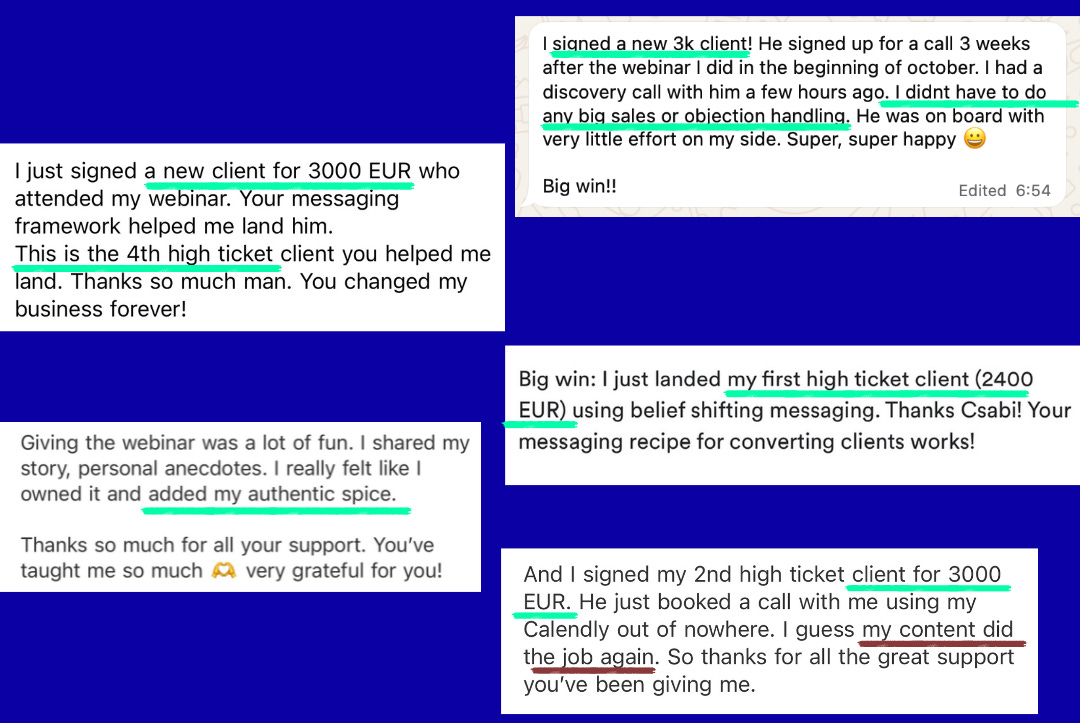
Simply more bite that brought him over €13,500 within just 90 days of being a member of Impact, my messaging membership.
And here’s where it gets uncomfortable for a lot of purpose‑driven entrepreneurs.
They’d rather write the next article, script their short-form video, or think about how to articulate their depth better,
because it feels like a betrayal to our expertise to “dumb down” our words.
We may also not want to attract just any rando to our content by making it way too simple.
Refusing to mirror your people’s language and therefore not mastering their reality the way they describe it is not protecting your depth.
It’s self‑centred.
It keeps the spotlight on how you want to sound.
Of course they aren’t buying.
And to be fair, we’re biologically wired to forget what it feels like to be in the thick of the problem. As our brain is building expertise, it stops remembering how confusing it was without it.
That could be the reason you have peers in your comment section, not clients on your waitlist, who can’t wait to be in the room.
You essentially built demand for your peers to chime in.
And if you’re an overachiever like me who’s famously hard on themselves, there’s another layer most people won’t name out loud:
it’s safer to pour all your energy into content and see the engagement rolling in than to sign a contract and take responsibility for a real client.
Posting three times a day lets you feel productive, virtuous, “in service” — without ever stepping into the vulnerability of,
“Oh shit, now I’m responsible for someone’s transformation, and they’ve paid me for it.”
(We’ll save how to handle that issue for another article.)
So your brain defaults to the safer hard thing, overworking on content, overfunctioning for people who’d never pay, instead of the actually meaningful hard thing:
learning to speaking in a way that gets you hired.
And not just hired.
Hired easier.
Because what entrepreneur wants to spend years posting content for an audience out of whom none actually wants the paid container?
And I’m not talking about not posting content for free. I’ve been sharing long-form content for the past 6 years, and I never missed a week. Because I believe in giving without expectations.
But as a principled, self-integral business owner I also have a duty:
Signal to my committed soul-aligned clients:
there’s an easier, ethical, science-backed process to help you attract high-agency clients to your business than than following all the bullshit advice about “just keep posting consistently, tirelessly nurture and your high-ticket buyers will magically appear.”
You’re allowed to stop trying to be the deep and impressive but confusing swamp, and start being deep and crystal clear spring, and make it easier to buy from you.
You’re way too smart, experienced, and valuable to spend years trying to convince people they don’t want what they actually want, and that they do want what you’ve decided they should.
I’ve run the “Sell like YOU” sales challenge for purpose-driven entrepreneurs two times now, and this time we’re centreing each of the 21 days around the most overlooked yet powerful concept that will get soul-aligned, committed clients into your orbit: demand-building.
If you:
have been posting long-form content for the past 4-6 months, and you haven’t got a single enquiry about your services in the DMs, or people don’t click the links when you’re offering a call or selling your digital product,
want to find ways to both help your audience with your free content, and use your content to bring clients into your DMs without having to manipulate anyone,
know how valuable your coaching services are, and still find it hard to articulate that value to your audience,
join the Sell like YOU Challenge here for just $33.
21 days, 3 weeks, each week dedicated to one converting content type.
I designed the challenge in a way, that the daily task won’t require you more than 10 minutes of reflecting and thinking, so by the end of the challenge, you’ll have a bank of ideas you can infuse into any long-form content, essay, podcast or video that doesn’t just educate your people, and generate conversations,
it gets the grown-ups in motion, so you have more enquiries, people booking calls with you, and asking how you can help them transform.
The challenge starts on 20 July.
Those of you who join before 16 July will also get the 56 most powerful copywriting techniques that move people without convincing anyone, which took me 6 years of consistent content creation, email writing and launching to put together.
Click here to get into the challenge, and snag your bonus right now.
Not better...like you 😎👍
Csabi, the three questions the brain runs before it moves:
1. Is this about me
2. Do I feel safe
3. Is this simple enough
That's the whole game right there and you serve it up daily!
The Jungian coach story is brutal and perfect. His work was real. His words were aimed at the wrong altitude.
You fixed the altitude, not the work.
Most people never make that distinction and you show people how. May the wise ones find their way to you and this offer 🫴 Great read.