

The Preacher Syndrome: They "Don't Get It" In Your Content Because of This
The structural shift that takes you out of only getting engagement, but crickets in the DMs, and into seeing clients ask about a path towards paid transformation.

You post another deep, honest piece you spent two weeks brewing in your head, three days putting it together, and another editing it.
People comment ‘This resonates!’ and share their thoughts.
Your DMs stay silent.
No-one has booked the clarity call you were promoting in the CTA.
Again.
And your first thought is: “How are they still not getting it?”

If this scene feels familiar, you’re not cursed.
And the years you’ve spent trying to get your message into the hands of people and build a business around it were certainly not wasted.
You may have just been playing one role on repeat:
the online preacher yelling sermons at people who never asked to come to church.
Any principled entrepreneur who’s spent their whole life as an underdog – bullied in school for being different, never feeling like they fit in – goes through this same Preacher Syndrome stage.
The difference between the ones who burn out here and the ones who start filling their high‑ticket containers isn’t hustling harder.
Or sharing another authentic piece.
You’ve already seen churning out more content won’t necessarily convert.
It’s what they do when they finally see this pattern.
And I didn’t just name it Preacher Syndrome because I flipped through a fucking self-help book.
I spent years in that role – the life‑long weirdo with a conscience, posting 3-5 mini sermons to prove I cared, wondering why the people I wanted to help most never moved to want to work with me.
“They just don’t understand me. They don’t see the value.”
I spent my entire childhood feeling like I was born into the wrong century.
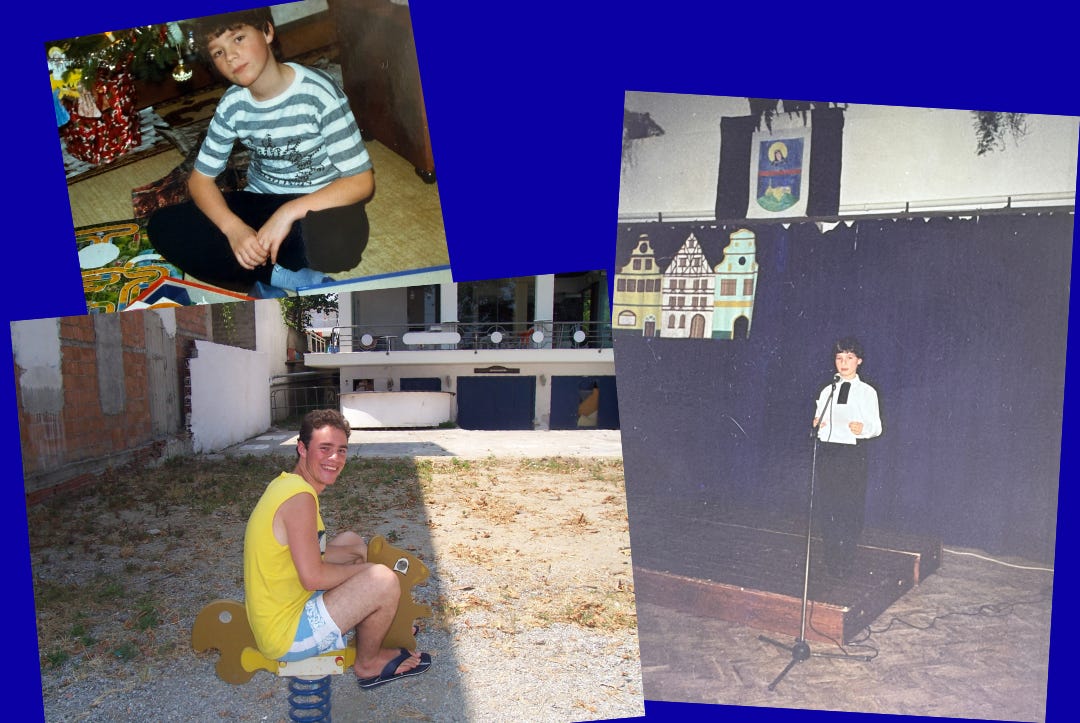
Too emotional. Too much of an eager beaver. Too critical of the world.
The top-of-the-class Csabi everyone was laughing at for having unrealistic ambitions.
My parents did all their best to support me,
but even they made me feel crazy for wanting to cut ties with my country at 22, and try my own luck elsewhere.
No wonder when I started posting online in 2020, every single time I shared a post, the gremlin in my head kept getting stronger:
“Who the fuck cares about you anyway?”
If you recognise any version of that gremlin in your own head, you can probably guess what happened next.
Thousands burned on content creation courses.
A hundred freebies on “magnetic content” collecting digital dust on your drive.
Feeling the frustration around “Fuck, I’d wasted yet another peace to call my people forward.”, swallowing it, and posting again hoping that this time, someone will get it.
The pattern was running so deep I didn’t realise how selfish that was.
Because that’s what Preacher Syndrome really is.
It looks like devotion – “I discovered something that I really want people to get.” – but underneath, it’s still about us.
Our need to feel understood.
Our need to prove we care.
Our need to convince ourselves we’re meant for this, while trying to convince everyone else.
And as long as sales is about me, myself and I, your ‘ethical impact‑driven business’ will stay a beautifully worded but expensive hobby.
You cannot convince another person of the value of doing the work.
Call it identity shift, nervous system rewiring, or skills-building.
And yet, that’s exactly what most “preacher content” tries to do:
The 1,200‑word article on why “perfection is self-sabotage,” written for people who still secretly believe they can only start when they’re ready.
The vulnerable essay about your burnout and rebirth, posted to an audience that has never invested in anything beyond self-help books.
Your longer Notes sharing something fundamentally important your commenters agree with, yet they come back to you with the exact same problems 6 months from now.
None of these are wrong.
They just weren’t written for the people who were actually ready to move.
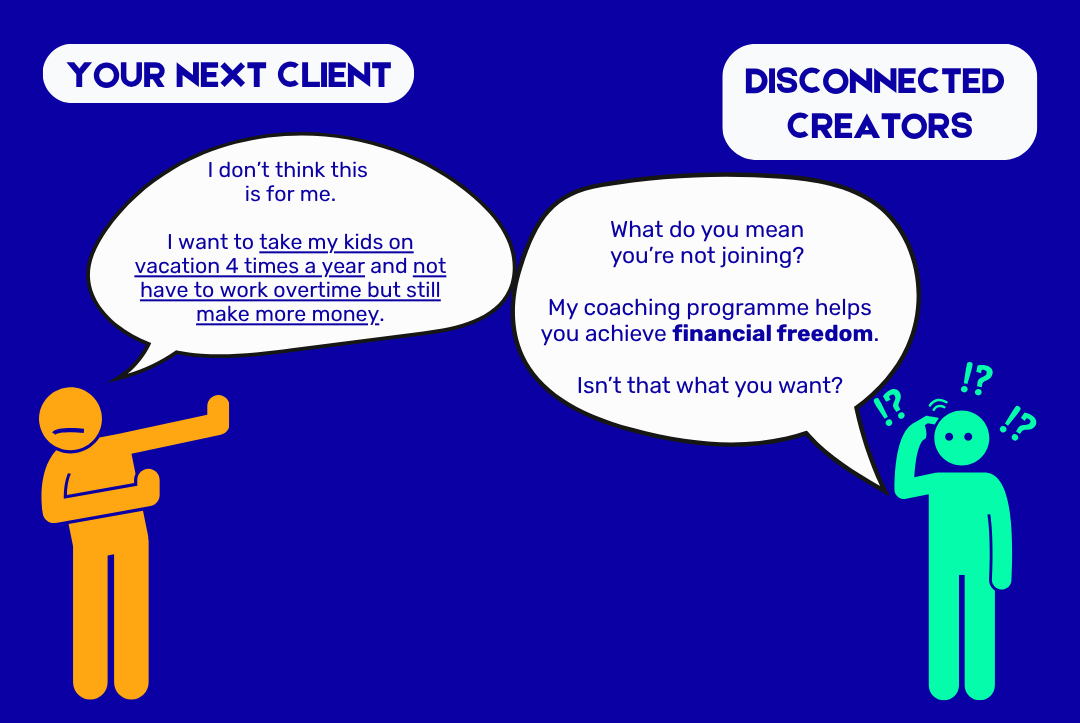
They were written to try and drag the not‑ready into your timeline – and to soothe the part of you that still needs to feel like you’re “doing enough” because, of course, when we see the likes and comments, we believe we’re doing something important.
So you keep explaining. Again and again.
Because at some point we all accepted that if we just explain more, if we just make more statements, give away more insights, people will finally get it.
But how many times did you explain to your best friend the consequences of staying a doormat in the office – and watched them go back to the same desk every Monday?
Have you had a partner who you explained to why it hurts when you can’t sit down and just have a conversation about the relationship – and nothing actually changed?
It’s the same thing in content.
Explanations never create the spark you hope someone needs to say yes.
They just give our people better vocabulary to talk about their problems.
The belief that keeps them stuck stays exactly where it was.
You write “Perfectionism is self-sabotage.” They’ll read “I know, I know… I’ll start as soon as I feel ready.”
Your vulnerable article about your rebirth after burnout lands as “Good for them… I just need to push through a little longer.”
Watch how strong your need is to convince.
Watch how disturbed you get when people aren’t convinced.
Because if their disbelief shakes you that much, it means there’s still doubt inside you. The ‘They don’t get me and I have to get them to get me to feel whole’ script is still firing.
You’re not just preaching to them.
You’re trying to preach yourself into certainty.
Every impact-driven entrepreneur I’ve taught who later became capable of helping others transform started here.
That season where you feel isolated, misunderstood, and honestly… a little too intense about getting people to see what you see.
The point isn’t to skip it or lean out.
It’s to not build your entire business model only around what you want to say, and focus on what you do have control over:
Not trying to expedite everyone’s timeline
because you need everyone to understand the value of your work.
Instead, speaking to the ones the ones who can feel the cost of staying where they are and are just waiting for someone, in an ocean of noise and vague, smart-sounding self-centred messages,
to name it clearly enough.
Those are what we call your Power Players in our space.
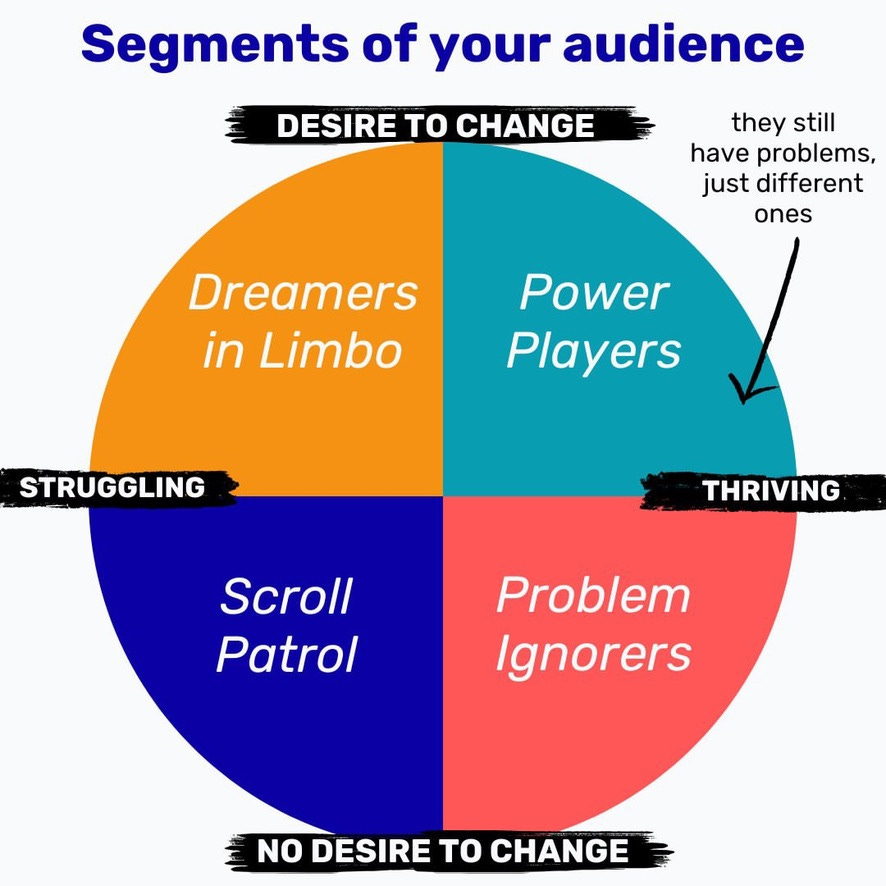
You also have control over one more thing:
whose awareness you’re centring.
I don’t talk about “knowledge transfer” for a reason even though that’s the expertise I’ve built being in adult education & communication for over 17 years now.
In four years of doing this work, I’ve never had a single client tell me that what they were struggling with was ‘knowledge transfer’.
They still feet lost around creating content that sparks a light under the right people to move without feeling like they have to send endless DMs or manipulate.
And yet, look at who shows up in your comments.
How many of them are peers agreeing with your take, people regurgitating your message in their own words, while no one is reaching out in the DMs saying, “I’ve never seen it that way.”?
That’s what happens when you keep speaking from your own awareness of the problem, not how it shows up in the model of reality of someone who can’t wait to hear the words that subconsciously signal “Shit, that’s exactly what I’m going through”.
See the self-fulfilling prophecy playing out?
When you come from the belief that people won’t get you, reality gives you more and more experiences of people not getting you.
And the explanations you leave people with may get them the momentary relief, but no fundamental change in their live, stuck in a loop of constantly relying on more content and information.
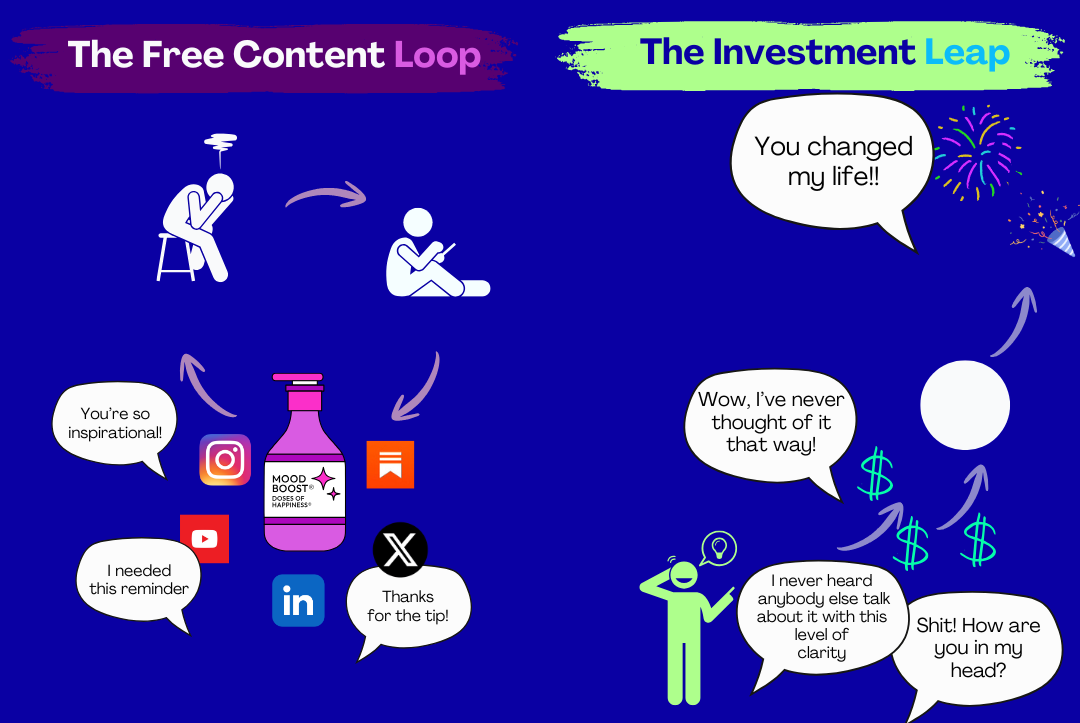
And until you learn to observe that impulse clearly, your communication will push the right people away,
because you may just have never sat with the question:
“What does my soul-aligned client need to hear to see their gap?“
Real wisdom adapts itself.
If you believe identity is the lens we see the world through, you don’t hide behind “this is just how I talk”.
You’re choosing an identity every time you create:
🅰️ the preacher on the mountaintop,
🅱️ or the guide who walks down the trail to meet committed people who want to move where they actually are.
I almost had to burn down my business because I unknowingly chose the identity of the expert who would rather flaunt his knowledge and keep recreating the same ‘They don’t get me’ scenario.
I can tell you that it takes work.
And the deeper you are in your craft, the more experience you have lived, the harder it will feel meet people where they’re at,
and the more resistance you’ll see with increasing the number of people asking about your services, clicking the links you offer in your content, and the impact you can make on their transformation.
Your first instinct, just like mine was, is probably to talk shit about yourself.
Don’t do that.
Start noticing the pull.
The times you’d rather share something from your awareness, and calling it “I’m just sharing my perspective”,
the self-talk happening when, yet again, no-one’s reaching out.
And to pull the right people into your world who you want to work with, those action taker, high-agency clients who will bring rave reviews about your services, ask yourself first:
“What does my soul-aligned client assume is the solution to the problems I can help them with?”
“What guru advice do they subconsciously take on that I can speak against?“
“What is it that they see everyone else in their space doing, assuming that it’s the right way?”
It’s psychologically impossible to invite someone else into a new belief
when you haven’t helped them first see the myths, outdated norms, misconceptions, limiting narratives that are still deciding 95% of how they show up in life.
Once one of my student got this, with an audience of 700+ followers but no one-to-one client, his soul-aligned client reached out, and wired him €2,400 without my student having to ‘sell’ to him.
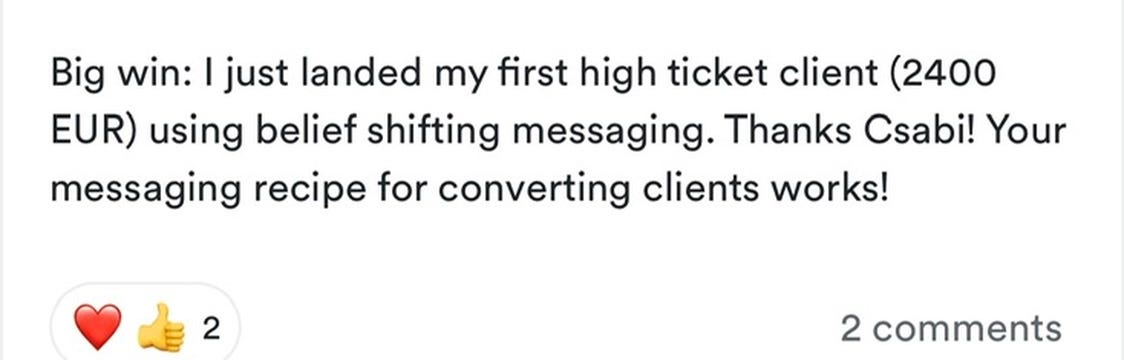
All his content did was punch holes in the beliefs his client was operating from, and made the consequences of that belief undeniably clear, before he helped the feel safe considering an alternative.
This is in sharp contrast with how Invisible Creators share content online, churning out more explanations, posting consistently and calling it “value.”
And that’s exactly why it works.
It helps the guide stand out, translate their wisdom into life-changing revelations, and get the right people’s attention.
The ones that no longer seek validation from posts, but reflect, see the creator’s solution as the obvious choice, reach out and send over thousands of dollars without having to be convinced.
If you’re a mission-led entrepreneur who wants to see how articulating your genius, and unique gifts, skills and passions can help you sell without having to manipulate anyone into your high-ticket offer,
join my free community (Click here) for further discussions, trainings, insights and conversations around how you can do that when you choose to share content differently.